 Okay, I’m cheating again. This isn’t actually a flower either. It’s another shrub! Rose of Sharon is a classic shrub. It can look like a small tree. I keep mine trimmed to be full bushes around 5 feet high. This particular variety is called Aphrodite and you can see why…huge two-toned pink flowers are showstoppers. They look quite exotic for a hardy perennial shrub in Illinois. Indeed, Rose of Sharons are part of the dramatic hibiscus family – except they can handle our winters. Just give them full sun and a lot of space and July through frost, you will enjoy an amazing show.
Archive for July, 2010
Summer-Proof Flowers: Aphrodite
Posted in Uncategorized on July 28, 2010| Leave a Comment »
Summer-Proof Flowers: Limelight
Posted in Uncategorized on July 27, 2010| Leave a Comment »
I’m starting a new series of posts today. I call it “Summer-Proof Flowers”…because there’s nothing as hard on a garden as summer at its height. That might seem a weird thing to say, but the intense heat, and the bouncing between droughts and flooding that is common in a Chicagoland summer, is just too intense for faint-of-heart flowers. Also, many of our go-to perennials, like salvia, phlox, yarrow, speedwell, and lily, are kaput by late July. Once you deadhead all these, what are you left with in your yard? So I took a good inventory of what I was left with and found a new appreciation for my late summer performers.
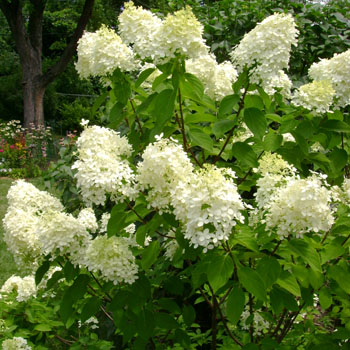 The first featured flower in this series is not a flower at all. It’s a shrub! Limelight Hydrangeas are a miracle. Seriously, if you don’t have one, buy one. Now. I’ll wait. This sturdy upright shrub (it can reach 6 feet tall, but you can trim it to your liking) is covered in huge fluffy flower cones beginning in mid-July. They start out a bright greenish white which slowly turns to all white, then as summer wanes, they become a lovely pink/bronze color. And unlike other, fussier hydrangeas, these are reliable bloomers year on year with no intervention or soil additives needed. Nothing is more spectacular in mid to late summer. I have several Limelights in my yard and will like plant several more in years to come.
The Better Sunflower
Posted in Uncategorized on July 20, 2010| Leave a Comment »
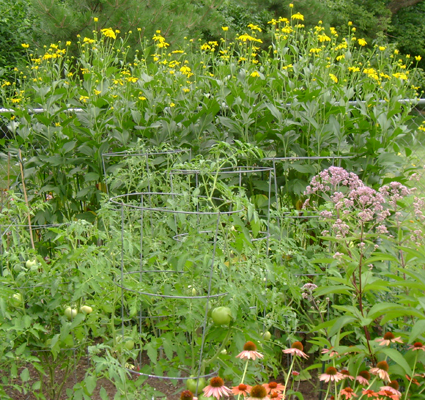
I like having tall flowers behind my veggie garden. So of course I initially turned to traditional sunflowers. But they turned against me. Literally. The flowers faced south, which means they were pointing AWAY from my yard. Yep, I got to look at the backs of the sunflowers. Not that pretty. Plus, they flopped and then got covered in ants. Yuck! Then I found a much better sunflower. It’s a perennial called “Shining Coneflower” (specifically, Rudbeckia hybrid “Herbstsonne”). It reaches nearly 6-feet tall and is covered in yellow flowers from mid-July well into August. And after that, the birds will love to eat the seeds in the cones. If you want height, dependability, and outstanding color, this can’t be beat. I have three plants in a row (as shown in the photo) and they form a wall about 6-feet wide. They definitely make an impressive group.
Plant of the Day: Swamp Milkweed
Posted in Uncategorized on July 13, 2010| Leave a Comment »
 I know, I know. “Swamp Milkweed” is no way to name a perfectly lovely plant. You can call it “Asclepias incarnata” if you prefer. This robust native plant has nothing but good things going for it. It’s a host plant for Monarch Butterfly caterpillars; butterflies in general love it; it’s not picky about soil or moisture; it’s 4-feet tall and sturdy (no flopping); it’s disease resistant; and best of all, it gives long-lasting, sweet-smelling pink flowers in the height of summer. This plant is tough to find in the store, but mid to late summer is a good time to look for it.
Plant of the Day: Joe Pye Weed
Posted in Uncategorized on July 12, 2010| Leave a Comment »
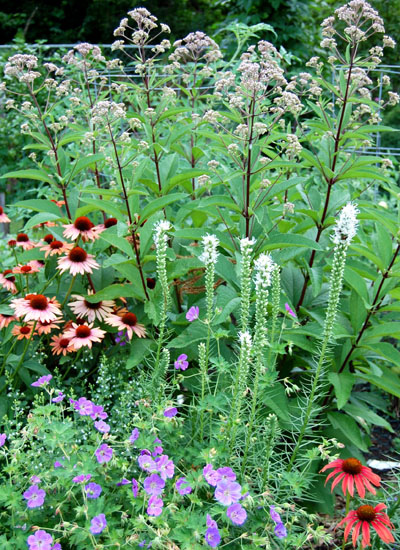 That’s right. I said Joe Pye Weed. Kind of an ugly name for a pretty plant, right? So let’s agree to call it Eupatorium. This native plant has gotten the star treatment from horticulturists lately who have given us gardeners choices other than the traditional 6-foot-high Joe Pye Weed. The plant shown in the photo is a hybrid called “Phantom” that only reaches 3 to 4 feet high. Perfect for most home gardens. I use mine to help screen my vegetable garden. The pale pink flower heads are just starting to bloom now, so they are great for a midsummer boost. I find the dark red stems especially striking against the lighter green leaves. Plus, this is a sturdy plant that does not flop. Just what I need to weather the storms of July in Chicago!
Beckoning Butterflies
Posted in Uncategorized on July 6, 2010| Leave a Comment »
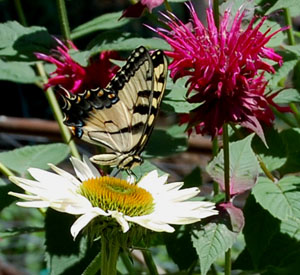 We gardeners work hard to attract butterflies to our yards. I sometimes judge the success of my garden by the number of butterflies I see. But times seem to be hard for our butterfly friends. Although I am planting more and more flowers to entice them, I see fewer and fewer. Usually only a couple of monarchs, a couple of viceroys, and the occasional yellow or black swallowtail. The monarchs hit the milkweed, while the swallowtails prefer the phlox. All of them like coneflowers and buddleia. (I’ve also discovered the monarchs are the most camera shy…and they like to chase sparrows!) I wish more people would plant native flowers to support these amazing creatures. I fear one or two butterfly-friendly yards on each block are not going to bring back the butterflies in the numbers we hope for. We need a serious wildflower infusion throughout our neighborhoods, not just in the occasional park.
Time for Tall
Posted in Uncategorized on July 1, 2010| Leave a Comment »

July is the time for tall flowers. Showy flowers. Sure, we thought May and June were pretty great, but on the whole those gentle months bring small to medium-sized, perfectly under control mounds of flowers. Now that it’s July, you’ve probably lost control of your garden completely to ostentatious giants like tall bee balm, balloon flowers, Shasta daisies, coneflowers, Culver’s Root, Joe Pye-Weed, tall phlox, lilies, and butterfly bushes. Things are growing on top of and in between each other, plants are climbing other plants, and the colors have gone kaleidoscope bright. Add a spray of water from your sprinkler and just let yourself be dazzled. There are so many choices of plants that are 36, 48, or even 60 inches tall! If you don’t have anything more than a foot tall in your garden, it’s time to build upward!
 Cait's Garden