I was thinking of Annabelle Hydrangeas while bike riding today. (The mind wanders when bike riding.) If everyone is not aware of this, let me caution you: it is wise to buy new Annabelles when they are flowering. Why? Because such a thing as a “dud” Annabelle exists. (That’s not the technical term, but it works for me.) Instead of forming the huge rounded globe of blossoms we expect, a Dud Annabelle will form anemic looking flat mop-heads of flowers that attract wasps. I once ended up with duds when I bought shrubs from a local garden center. When I tried to take them back because they were duds, the owner told me he had a degree in horticulture and I didn’t and there was no such thing as duds. His explanation for the wacky flower head was that I neglected the shrubs. Jerk! Well, I consulted a few garden advice sources and found out there is, indeed, such a thing as a Dud Annabelle. This happens when the cultivar reverts back to its wild state. Like a mutation. The only way to make sure you don’t buy a mutated plant is to buy it when you can see its flowers have formed correctly. None of the other types of hydrangea have this problem, as far as I know, so those you can buy safely before they flower. Just not Annabelles! I took a risk myself this year by buying the new pink Annabelle hybrid without flowers. But it seems to be forming flowers correctly now. Whew!
Archive for the ‘Uncategorized’ Category
Buy Annabelles with Caution
Posted in Uncategorized on May 27, 2010| 1 Comment »
Highs and Hangovers
Posted in Uncategorized on May 26, 2010| 3 Comments »
Gardening is addictive. Not so much the toil (I could do without that), but the plant acquisition. The high you get from buying a new plant, especially one that you have a) long-coveted that is hard to find or b) is a new introduction, is definitely a rush. Then comes the hangover, sometimes financial and almost always in terms of toil (‘Dang it…I need to plant those now!’)
I curb my impulses. I don’t buy just any plant anymore. I am picky. (I have to be, I’m running out of room.) But I can be seduced by the green leafy goodness. Case in point: today. A tip that the local Home Depot had the new Lo and Behold Blue Chip Dwarf Butterfly Bush for fairly cheap got me over there to buy one. [This new introduction stays about 2-3 feet tall and wide and doesn’t need deadheading.] Then a new, brightly colored, column-shaped barberry bush called “Orange Rocket” caught my eye (just $12.98 each!…so I got 3) and there you go. Big high, lots of hangover. Have to move 3 large perennials to make room for these beauties. Had to stop and buy dirt. It’s going to be a big project. But the end result will hopefully be a season-long tall drink of color in a kind of underwhelming section of my garden (thanks to the new barberry bushes) and more happy butterflies in my yard (thanks to the new buddleia) .
Feverfew: The Best Filler Plant Ever?
Posted in Uncategorized on May 24, 2010| 1 Comment »
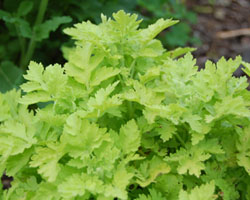 Feverfew is technically an herb, yet it’s become one of the most useful plants in my garden. Bright yellow-green with a parsley-like leaf, this plant starts out a few inches high and grows to 8-10 inches high and wide. In midsummer, it blooms with tiny daisy-like flowers, and then it kindly makes more of itself by seeds, most of which germinate the next year. It’s not invasive. At worst, you have to rake up a few tiny feverfew you don’t want. At best, you have an endless supply of one of the best garden filler plants I’ve ever seen. It’s easy to transplant seedlings wherever you need them. I find the bright color really pops in those bare spots that crop up in every garden, or along borders. And it’s also easy to share extra plants with friends. That’s how I got mine in the first place! (Thanks, Mom.)
Hostas Rock!
Posted in Uncategorized on May 22, 2010| Leave a Comment »
Think they don’t rock? Well, you must not have been paying attention to all the varieties available now. Forget about the old-fashioned hostas we remember lining our backyards when we were kids. You know, the smallish green leaves with the white borders and stripe down the middle? Nobody wants to see those hostas anymore, unless it’s for nostalgia. These days, leaves of green, blue, gold, and even white can be found in varied sizes and with all kinds of exotic color combinations. Some hostas require full shade, but many are available that tolerate part-sun. I have three such plants in my backyard, Big Daddy (huge, rounded bluish-green leaves), Gold Standard (large yellow-green leaves edged in dark green…they almost glow!), and August Moon (bright yellow leaves that tolerate the most sun out of all my hostas). Planting hostas in the right spot in your garden can turn a plain area into a lush tropical setting in no time. Hostas can be pricey at local nurseries, but great deals can be found at big box stores this time of year.
The Season Ends for a Spring Favorite
Posted in Uncategorized on May 21, 2010| Leave a Comment »
 It’s a sad time of year for me. The time when my beloved pansies will be taken down by an 80+ degree heatwave next week. Pansies (like me) cannot abide hot temps. I still recall the excitement of bringing home that flat of pansies this past March. The first flowers of the year, and wow, how stunning they’ve been these past two months. Sure, it’ll be fun to re-do the planters in summer flowers, but it’s still a bit sad. I will try to move my planter pansies into a cool spot in the garden and with luck, they will take a second bow this autumn.
Mad about Mainacht
Posted in Uncategorized on May 20, 2010| Leave a Comment »
 I like to call “May Night” Salvia by its German name “Mainacht” because it’s a German cultivar…and because it’s just fun to say. I consider this the mack daddy of all purple sages. Bold and robust, from its deep, almost neon-bright blue-purple color to its long, bushy spikes of flowers, it makes a statement. Deadheading provides a smaller show of flowers in midsummer. Best of all, the bees love this plant, ensuring many photo opportunities!
Border Patrol
Posted in Uncategorized on May 18, 2010| Leave a Comment »
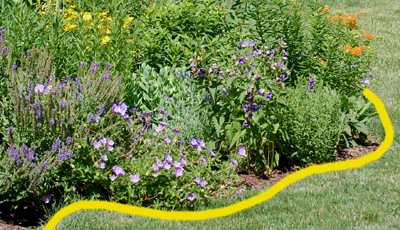 Keeping a purposeful border between our garden and our lawn takes commitment. The lawn is determined to steal back the spaces we’ve claimed from it. So every spring, it’s time to grab the sharp shovel and clean up that edge. When your garden gets big, that’s a lot of edge! I have spent many an hour sitting on the ground, shaking dirt and worms out of chunks of removed turf. One good thing about my borders, they are free-form curves. (See the yellow line in the photo as an example.) With curves, it is easy to enlarge the garden just enough to fit in one more plant. Or two. Or three. Just bump out the border with another curve! You can’t possibly mess it up; no measuring or mapping out lines is involved; and best of all, it looks really soft and pretty.
Focus On the Positive
Posted in Uncategorized on May 17, 2010| Leave a Comment »
It’s a cloudy, rainy day and I am reminding myself to focus on the good parts of my garden instead of worrying over the not-so-good. Living plants are a moving target. For every reliable flower or shrub, you have one that mysteriously disappoints, either due to weather, bugs, dislike of its location, or mysteries beyond your knowledge. This failed plant can look like a giant blight on your beautiful landscape to a fixated gardener. But we must remember to look at the big picture, as visitors to our garden will do. They won’t notice that one under-performing plant. They’ll be too busy looking at our gorgeous successes. The trick is to learn to look at the big picture ourselves!
Plant of the Day: Spring Aster
Posted in Uncategorized on May 16, 2010| Leave a Comment »
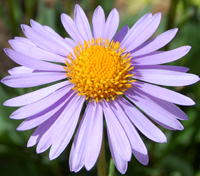 Why wait until September for asters? With the cultivar called “Wartburg Star” (ugly name, pretty plant) you can have cheerful, delicate purple asters in May. They are hardy to Zone 4, easy to grow, and like Fall asters, spread very slowly by rhizomes, so divide them every couple of years. Spring Asters are also called “East Indies Asters” because they originate in the Himalayas. Pretty exotic, huh?
Plant of the Day: “Pink Delight” Salvia
Posted in Uncategorized on May 15, 2010| 2 Comments »
 I love all kinds of salvia. Most people know the purple varieties, but for the earliest blooming sage, pick this charmer for your garden. The plant shown in the photo is a Meadow Sage (Salvia Pratensis) called “Pink Delight” and can now be found in your favorite garden centers. It starts blooming in early May and continues for several weeks. Its generous pink flowers always cheer me up.
 Cait's Garden