Archive for the ‘Uncategorized’ Category

I think this gets the nod for the last perennial in my garden to start blooming. This “Japanese Windflower” or “Anemone” is called “September Charm” because it does indeed start blooming in September. In my case, late September. And thanks to our lack of frosts so far, this is what this plant looks like now. You’d swear it was Spring! Indeed, this plant looks like it belongs with the spring flowers. A light, airy plant with delicate pink flowers born on thin stems (making it look like flowers being tossed in the breeze), this plant seems disconnected from the robust golds, reds, and browns of fall foliage. I wondered this year if I should move it to a different location in the yard, but I honestly couldn’t think of anywhere where it wouldn’t look out of season. And it seems to be happy where it is. So I will just enjoy the oddness of this fresh little flower on an October day.

Read Full Post »

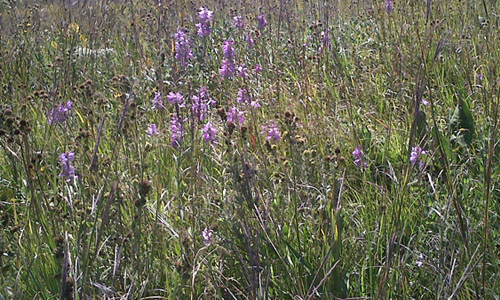
Obedient Plant deserves a shout-out at this time of year for delivering on the promise we waited for all year. In fact, every year I forget I have this tough garden staple until it suddenly opens with these amazing flowers in mid-September. This is why we plant flowers that bloom in the fall, for giving us fresh color when we start thinking the season is done. Plus, the bees really appreciate them now. The photo to the left is a glamour shot from my civilized garden, but below is a phone camera shot from a recent walk at Crabtree Nature Center. Seems there is a version of Obedient Plant out on the prairie, too! Score one for native plants, yet again.

Read Full Post »

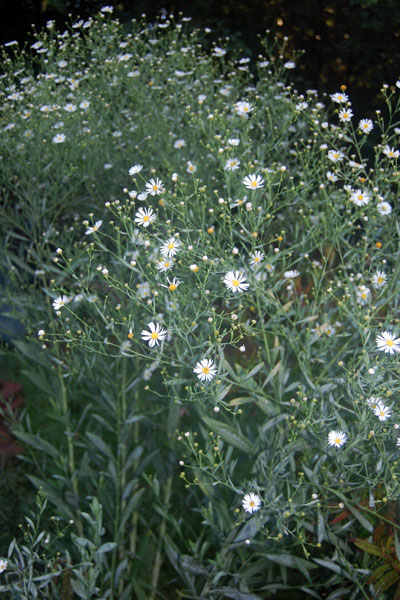
Last year, about this time, I posted a photo of a scraggly little slip of  a plant I had just purchased called “Boltonia asteroides,” an American wildflower also called Wild Aster. The label said it would get to 4 feet tall and 3 feet wide and boy, they were not kidding. That plant shot up this year to impressive size. I was even able to give a clump to a friend in early spring. I can’t say enough good things about this plant. For much of the season, when it isn’t flowering, it looks like pale green tall grass. Then when it finally does bloom in September, well, you can see the photo. Amazing, isn’t it? I’ve read that, as with common asters, one can pinch these stems back in early July to keep the plant shorter later on. But I personally get a kick out of a flower that sees eye to eye with me. Definitely do not pass up the chance to own that scraggly looking, tiny pot of a wildflower in your garden center when you see it. I am so pleased with the performance of my native plants this year!

Read Full Post »

All Season Standout

I’ve blogged about this shrub before: “Sunshine Blue” Caryopteris (aka “Bluebeard”). Purchased from a mail-order nursery as a tiny seedling a few years back, it has become an anchor in my garden. Most of the summer, the show comes from its naturally rounded form and its dazzling yellow-green foliage. It’s always a bright spot in the yard. In September, we have an even more splendid show as periwinkle blue flowers blanket the shrub, making this a much-needed haven for bees and wasps in addition to a show-stopper. I adore this plant. Nothing in my garden provides this much gorgeousness from the time it leafs out in the spring until the leaves fall in the autumn. Highly recommended if you have a sunny, not too wet spot in your yard.

Read Full Post »

Going “Native”


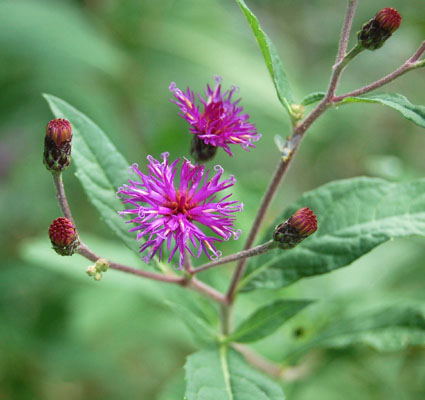
It is September and the plant otherwise known as “Ironweed” that I purchased early this year is 3 feet tall and flowering as promised. As you can see by the photo, it’s much too pretty to be called Ironweed (its other name “Vernonia fasciculata” is more appropriate). Yet I do get perverse delight in calling lovely native plants by their often ungainly names, like Ironweed, Swamp Milkweed, and Joe Pye Weed. You note the trend there…the word “weed” pops up often. Thus proving the old adage that weeds are only flowers in undesirable places. I wouldn’t go that far. My native plants do not seem to be in the same league as the detestable dandelion. Yet a visitor to my garden recently pointed out, ‘I can tell it’s a native plant because it’s tall and stalky.’ Yes, native plants are often a bit lean and rangy. They definitely assert themselves in the landscape, which makes them charmingly American, I think. Maybe somewhere in an English cottage garden, there’s a British gardener coveting our “weeds.”

Read Full Post »

The two fluffy white Limelight hydrangeas in this photo are not different sizes due to forced perspective. The one in the foreground is more than twice the size of the one in the background. Both shrubs were purchased at the same time from the same store and started out the same size, one on either side of my front door. The smaller shrub is actually in better quality soil than the larger one, which is kind of stranded on a patch of earth between the sidewalk and driveway. The difference? Sunlight! Both face west, but the smaller shrub gets shading from the house, whereas the larger shrub is outside of the shade’s influence, on the corner of the house. It gets full sun from almost all sides. I believe this shows the difference the sun can make to sun-loving shrubs.

Read Full Post »

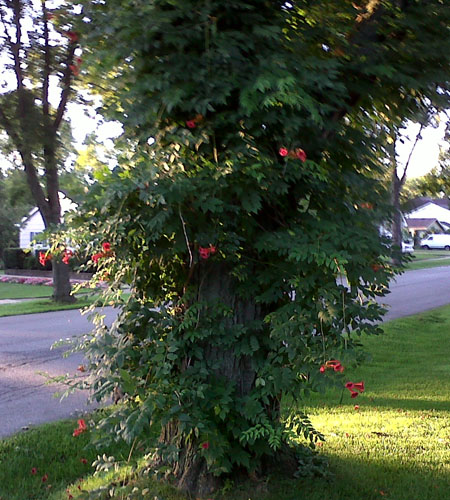
I had to snap a photo of this amazing sight I saw while walking around the neighborhood this morning. At first, I thought the trees were starting to turn colors a bit early. Then I realized these weren’t orange leaves, but orange flowers. Yes, my friends, this person is growing an extremely large bugle vine on an extremely large tree. The vine goes up about 16 feet or so. Since the tree is on a corner, it’s getting enough sun from the sides. I do wonder what the squirrels think about this, but I admire the fact that someone finally found a place where a bugle vine has enough room to grow to its full height.

Read Full Post »

This was a shot of my vegetable garden from about two months ago when everything was full of promise. Let’s focus on that shot, because the current one isn’t as pretty. For the fifth year in a row, I have proven a mostly unsuccessful vegetable gardener. I don’t know how the farmers in Illinois ever grow a crop with our bizarre weather.  My one success this year was preventing early blight on my tomatoes. I think it was the regular application of liquid copper fungicide. These are the tallest tomato plants I’ve every had…and the leaves have stayed green, too! I’ve had one great tomato harvest and now am hoping for another good crop of tomatoes to prove that I really was successful at growing them this year.

To me, as long as I have a good tomato crop, I count myself lucky. There is no substitute for a home-grown tomato. Fortunately, there ARE substitutes at the store for my garden fails, like cucumbers and pumpkins. I learned that you can’t get cucumbers or pumpkins unless the bees do a good job fertilizing those pretty yellow flowers. Blame the world-wide bee blight, but my flowers did not turn into pumpkins or cucumbers. And then last week the blight set it anyway and turned all the green leaves to brown-spotted horrors. The vines have been excised. Garden fail. On a related note, the lettuce turned out bitter this year (won’t be trying that again) and the cilantro was pickable for only a heartbeat. Barely worth planting. Peppers also give me trouble. The bell kind anyway. So far, I have had one excellent pepper from each plant. Just the one pepper. Can’t explain why exactly.

The pole beans are interesting looking. A pretty green wall. The bean yield has been sparse, but at least they are still alive and producing. Therefore, they make the cut. What cut? The cut of the crops I’ll grow from now on. I am done with cucumbers, squash, pumpkins, lettuce, and most herbs. Next year, I am only growing tomatoes, jalapenos, and bell peppers (despite their sparse yield), plus another go at the pole beans. I have had enough of struggling to grow anything else. As with my flower garden, I’ve learned what is hardy and thrives. Half the job of being a good gardener is knowing when to cut your losses and change plans.

Read Full Post »

Who can resist the plant sales that start in August? It’s like you realize the winter is coming and if you don’t buy plants now, you’re out of luck till next May. That’s too long a wait to contemplate for me. Plus, I’ve gotten some of my most unusual and beloved plants in August. August is a great time for buying fall bloomers and prairie plants. For the third year in a row, I’ve purchased an exciting prairie plant. This one is “Aster azureus” or “Sky Blue Aster.” If you live in the middle or eastern part of the country, this is probably the same tall blue aster you’ve seen by the sides of the road and in fields. It is supposed to tolerate any soil type imaginable and still thrive. My kind of aster! I love asters, but have so much trouble with rust and mildew on my old-fashioned short varieties that I’ve given up on those. This will be a tall, majestic beauty next August! (Right now it’s a pathetic few canes, kind of like a Charlie Brown plant.) I planted it next to my white “Swamp Aster” which is also a prairie plant. Should be an outstanding combo. Also purchased on this plant sale shopping trip was Harvest Moon Coneflower. Not my showiest coneflower, but an arresting light orange color with a pretty cone. And finally, Plumbago or Leadwort. This was a groundcover recommended to me by my mother. It blooms with deep violet-blue flowers this time of year, when flowers are most needed. All three plants were rather root-bound (one of the hazards of late season shopping), but some extra attention opening the roots up should fix that. I wish my three new babies good health for years to come.

Read Full Post »

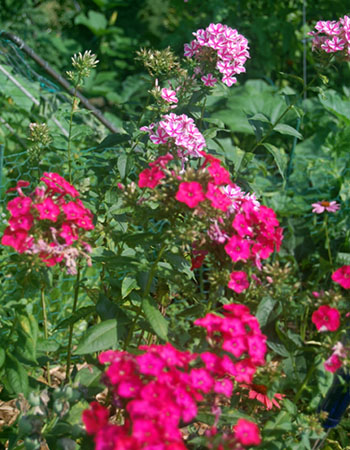
Okay, I’m being a bit dramatic. We gardeners are sensitive people. But tall phlox truly are a mixed bag in any given summer. Prone to powdery mildew, this plant has its good summers and its bad. I have collected varieties that promise to be mildew resistant, but not all live up to their claims. (Regular application of a liquid copper fungicide can sometimes help, but it rained too much to apply it regularly.) This summer, my usually hardy and spectacular Blue Paradise Phlox were taken out early by the incessant rains. But two newer varieties, planted just last summer, were surprising winners. Not only did they avoid the dreaded mildew, but they bloomed two weeks later than my other phlox, meaning that they have single-handedly extended my phlox season. Shown in the photo is Red Volcano and Candy Stripe Volcano (“Volcano” being a brand of phlox bred for mildew-resistance). The red is an unusually deep, hot pink and the candy-striped looks just as promised. A dazzling combination, I think.

Read Full Post »

« Newer Posts - Older Posts »