One of the pleasures of gardening is being able to show your garden to visitors. Sadly, not all visitors care as much about flowers as we do. But every now and then, you get a truly lovely compliment from a guest and it validates all your efforts. That happened to me this week. A visitor praised my garden for its variety. She said she enjoyed that it looked like a wildflower garden instead of something very structured. Since that is what I am hoping to achieve, that was high praise indeed. Sure, I plan some things. I consider plant height, sun/water needs, colors, and bloom time when I decide what and where to plant. I make sure something is blooming at all times in every section of my yard. But other than that, I buy flowers that please me and I don’t worry about whether they match anything else. I think that’s the secret to a true wildflower-look garden. Planned randomness!
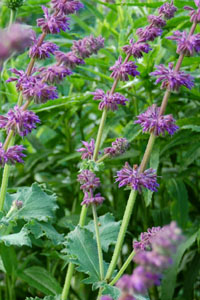 I can’t resist a new kind of salvia, so when I saw this beauty a couple years back, I snapped it up. Which is fortunate, as I’ve never seen it in the store again! (The fact that it shares the name of a Prince song is just a bonus that makes me laugh.) This plant is just as hardy as any salvia, but has unique “pom-pom” flower formations and rounder, curlier leaves than traditional salvia. Perhaps its rock star name refers to its looser, more free-flowing growing style. There is nothing rigid and upright about Purple Rain! This plant is just fun to own.
Posted in Uncategorized | Leave a Comment »
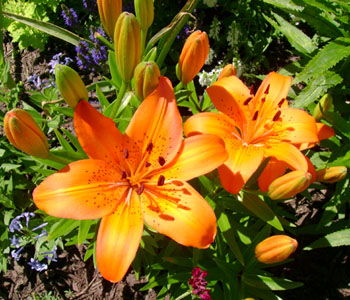 I admit it, I am not a fan of daylilies. I have limited garden space and they have too big of a footprint. Plus, I’m not a fan of their messy, spidery foliage. Instead, I have successfully turned my focus to Asiatic and Oriental lilies (such as the adorable “Orange Pixie” shown at left, a dwarf Asiatic lilium now in bloom in my garden). I have several dwarf lilies in orange, red, pink, and white, as well as a 4-foot showstopper of an Oriental Lily called “Royal Sunset.” The benefit of these plants (other than the huge blooms, tropical colors, and heady fragrance) is their neat and compact foliage. They rise up on narrow but hardy stems from between their larger, messier garden mates, bloom fabulously, and then stay relatively incognito the rest of the summer. No matter how crowded your garden, believe me, you have room for these! I hope to add more next season.
Posted in Uncategorized | 3 Comments »
I added a dash of frugality to the pots of flowers by my front door. I splurged on some lovely, large geraniums and reddish colored leaves. But I was left with the feeling I needed a splash of yellow-green, too. Instead of going back to the nursery for sweet potato vines, I turned instead to my favorite perennial filler plant, Feverfew (see May blog entry), which is the same color. I have so many clumps of feverfew in my yard, it was easy to find a couple to use in my planters. They give the perfect dash of color, and when the season is over, I can put them back into my garden.
Posted in Uncategorized | 1 Comment »
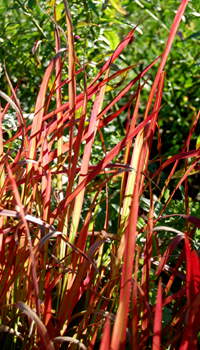 “Red Baron” Grass (also called “Japanese Blood Grass”) is a fabulous, easy to grow ornamental perennial. Unlike large clump-forming grasses (such as Miscanthus and Fountain) which require much maintenance due to die-out in the middle, each blade of Red Baron Grass grows individually out of the soil, fresh, every year. So what you get is airy, elegant, foot-long blades of bright green grass tipped with red that become fiery red-gold in autumn. Fairly slow-growing (I started with a small clump and six years later, that clump is about two feet wide), it’s easy to pull out unwanted stalks or to divide. It is, however, difficult to find in the store, so grab it when you see it, or ask a friend who has it to donate some!
Posted in Uncategorized | Leave a Comment »
 This perennial geranium was named the Perennial of the Year in 2008 and it’s deserving of that honor. Unlike old-fashioned cranesbill, which pretty much blooms once a season, Rozanne blooms from late May until frost. Best of all, it is very heat and sun tolerant. It grows in mound form to about 18 inches high and up to 3 feet wide, so leave some room for it. I have seven of these in my yard because they rock!
Posted in Uncategorized | Leave a Comment »
I was thinking of Annabelle Hydrangeas while bike riding today. (The mind wanders when bike riding.) If everyone is not aware of this, let me caution you: it is wise to buy new Annabelles when they are flowering. Why? Because such a thing as a “dud” Annabelle exists. (That’s not the technical term, but it works for me.) Instead of forming the huge rounded globe of blossoms we expect, a Dud Annabelle will form anemic looking flat mop-heads of flowers that attract wasps. I once ended up with duds when I bought shrubs from a local garden center. When I tried to take them back because they were duds, the owner told me he had a degree in horticulture and I didn’t and there was no such thing as duds. His explanation for the wacky flower head was that I neglected the shrubs. Jerk! Well, I consulted a few garden advice sources and found out there is, indeed, such a thing as a Dud Annabelle. This happens when the cultivar reverts back to its wild state. Like a mutation. The only way to make sure you don’t buy a mutated plant is to buy it when you can see its flowers have formed correctly. None of the other types of hydrangea have this problem, as far as I know, so those you can buy safely before they flower. Just not Annabelles! I took a risk myself this year by buying the new pink Annabelle hybrid without flowers. But it seems to be forming flowers correctly now. Whew!
Posted in Uncategorized | 1 Comment »
Gardening is addictive. Not so much the toil (I could do without that), but the plant acquisition. The high you get from buying a new plant, especially one that you have a) long-coveted that is hard to find or b) is a new introduction, is definitely a rush. Then comes the hangover, sometimes financial and almost always in terms of toil (‘Dang it…I need to plant those now!’)
I curb my impulses. I don’t buy just any plant anymore. I am picky. (I have to be, I’m running out of room.) But I can be seduced by the green leafy goodness. Case in point: today. A tip that the local Home Depot had the new Lo and Behold Blue Chip Dwarf Butterfly Bush for fairly cheap got me over there to buy one. [This new introduction stays about 2-3 feet tall and wide and doesn’t need deadheading.] Then a new, brightly colored, column-shaped barberry bush called “Orange Rocket” caught my eye (just $12.98 each!…so I got 3) and there you go. Big high, lots of hangover. Have to move 3 large perennials to make room for these beauties. Had to stop and buy dirt. It’s going to be a big project. But the end result will hopefully be a season-long tall drink of color in a kind of underwhelming section of my garden (thanks to the new barberry bushes) and more happy butterflies in my yard (thanks to the new buddleia) .
Posted in Uncategorized | 3 Comments »
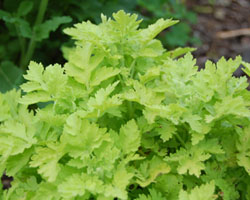 Feverfew is technically an herb, yet it’s become one of the most useful plants in my garden. Bright yellow-green with a parsley-like leaf, this plant starts out a few inches high and grows to 8-10 inches high and wide. In midsummer, it blooms with tiny daisy-like flowers, and then it kindly makes more of itself by seeds, most of which germinate the next year. It’s not invasive. At worst, you have to rake up a few tiny feverfew you don’t want. At best, you have an endless supply of one of the best garden filler plants I’ve ever seen. It’s easy to transplant seedlings wherever you need them. I find the bright color really pops in those bare spots that crop up in every garden, or along borders. And it’s also easy to share extra plants with friends. That’s how I got mine in the first place! (Thanks, Mom.)
Posted in Uncategorized | 1 Comment »
Think they don’t rock? Well, you must not have been paying attention to all the varieties available now. Forget about the old-fashioned hostas we remember lining our backyards when we were kids. You know, the smallish green leaves with the white borders and stripe down the middle? Nobody wants to see those hostas anymore, unless it’s for nostalgia. These days, leaves of green, blue, gold, and even white can be found in varied sizes and with all kinds of exotic color combinations. Some hostas require full shade, but many are available that tolerate part-sun. I have three such plants in my backyard, Big Daddy (huge, rounded bluish-green leaves), Gold Standard (large yellow-green leaves edged in dark green…they almost glow!), and August Moon (bright yellow leaves that tolerate the most sun out of all my hostas). Planting hostas in the right spot in your garden can turn a plain area into a lush tropical setting in no time. Hostas can be pricey at local nurseries, but great deals can be found at big box stores this time of year.
Posted in Uncategorized | Leave a Comment »
 Cait's Garden