Comedians of the Garden

image

Shasta daisies are old-fashioned garden classics. One of those flowers you shouldn’t have to buy because someone will always have extras to share. They also make me smile, and even laugh. What can be funnier on a hot summer day than three foot tall daisy flowers bobbing in the breeze?

The Bells, Bells, Bells

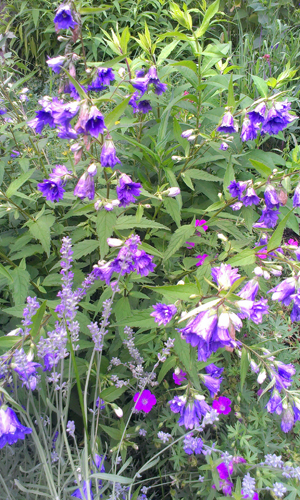
bellflowerI think delphiniums are gorgeous things. Such beautiful long stalks and such perfect bell-shaped flowers. Unfortunately, delphiniums are delicate and fussy and I’ve learned my lesson not to waste money on trying to get them to grow year after year in my garden. Although it’s not quite the perfect substitute, I have found that tall hybrids of campanula (aka bellflower) can be decent visual substitutes with none of the drawbacks and none of the delicacy. There is height, there are ruffly, bell-shaped flowers, and these bells won’t balk at anything summer throws at them.

Blue June

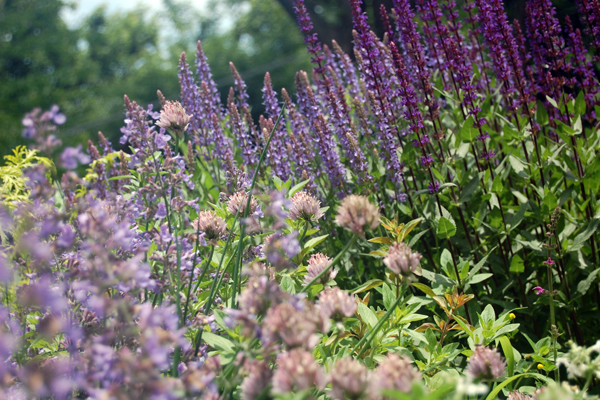
purple_june2013As June winds down, what was a sea of purple a week ago is now some dried husks in need of deadheading. Well, all but the catmint, which is still going strong. Through luck or accident, my garden is overwhelmingly “blue” in June. I use “blue” in quotation marks because almost no flowers billed as “blue” really are. Not blue like the sky, anyway. They are instead, inevitably, a shade of purple. The exception is delphiniums, which really are true blue. Unfortunately, they are too delicate a flower for my garden so I have to take a pass. Instead, I have plants, as shown in the photo, like catmint, several kinds of salvia, and even some highly ornamental clumps of chives (purple flowers AND you can eat them!).  These June bloomers tend to be very clump forming, creating masses or clouds of soft color. It really is quite stunning. Rather like a Monet painting. Now the changeover is occurring between the lush purple early summer bloomers and the showier, taller, wilder mid- to late-summer gang, such as the coneflowers, bee balm, and butterfly weed. What was once overwhelmingly purple will now be dotted with pinks, reds, oranges, and yellows…as it should be in the hot months when everything is more intense.

Purple Fountain Majesty

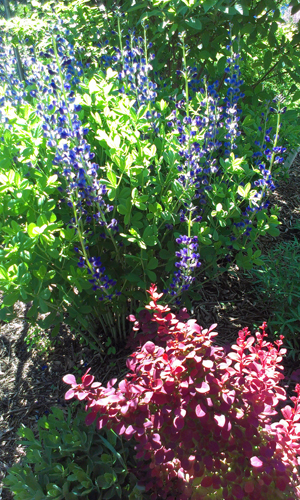
falseindigoBlue False Indigo, aka Wild Indigo, aka “Baptisia australis” is  a pretty phenomenal entry in the late spring/early summer flower category. Its time in flower is brief, but the show it gives is pretty phenomenal. I’ve heard the bright purple-blue flowers that run up the long stems referred to as “pea-like” but I think they look more like water fountains. Deep blue droplets splashing up against the bright green leaves. This is a very tall, vertical and vase-shaped plant. It gets about 3 feet tall. I have a clump of three plants that grew together and they are firmly entrenched in my landscape. They are at the back of the bed, though, so when they aren’t blooming (which is most of the year), they are a lovely green background for other plants. They stay very neat and tidy, too. Very upright, right through fall when they produce very interesting black seed pods. This plant now comes in a few different colors including yellow, but for my money, I will choose something that’s called and colored “indigo” every time.

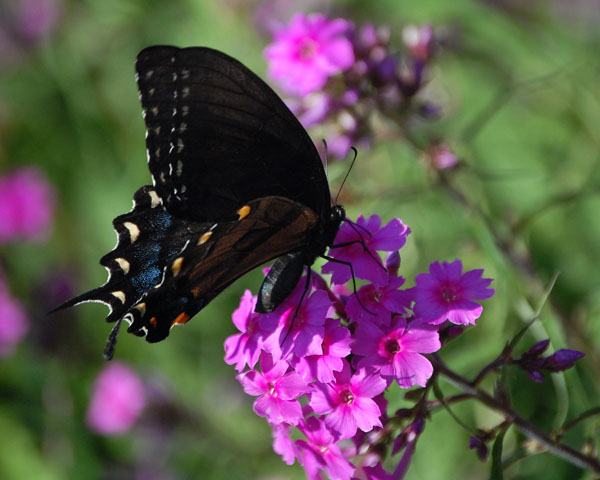
phlox_gramsThese are the pink phlox that have been handed down in my family for more than 50 years, ever since my grandma moved to a house where they were growing. Wherever she moved, she took them with her, and now my mom and I do the same. They are tall, they are pink, they are hardy. I don’t know what cultivar they are. They aren’t crazy and bi- or tri-colored. But they also never get mildew and they always come back just as robustly in the spring. The same can be said for the no-name pink and purple coneflowers and plain old yellow black-eyed susans. Robust, reliable, gorgeous. I have been seduced by many a “boutique” coneflower, phlox, and rudbeckia over the years. Especially the coneflowers…I fall for the fancy ones every time. But this year, I am drawing a line in the dirt. I am no longer spending $15 on a plant with a fancy name, because there’s an extremely high probability that plant will disappoint. It will come back weak next year, or it won’t come back at all. New cultivars are all flash and little substance. Instead I am moving around clumps of the old reliables to fill in the spots where the boutique flowers have faltered. That’s another thing about the oldies but goodies…they make more of themselves! Endless supply! And really, when faced with a perfect pink phlox, does anyone really care that it doesn’t have a clever name?

covertwoMulch has become a thorn in my side. Or should I say a sliver in my finger. Despite my desire to fill up my garden with growing things, bare spots persist that seem naked and vulnerable without a neat coating of chopped cypress. This is especially true of the long swaths of shrubbery that circle my house. You cannot crowd growing things, especially shrubbery. If a shrub will get 3 feet wide, then by golly, I’m going to give it 3 feet to grow. Cue the mulch! Ground cover can certainly work at times. Sedum is an especially pleasant and well-behaved ground cover. But I’d need about a truckload of sedum to cover the bare spots in my landscape. A more vigorously spreading ground cover could do the job, but I’ve heard horror stories of creeping leaves that swallow up everything in their path and that you can never rid your yard of again. No thanks.

So, we all run out and buy bag after bag of mulch. Every single year, because mulch has a way of disappearing. I’ve found cypress mulch has the best longevity. I also like the look of it around my shrubs. But it’s expensive and I need a lot of it. A couple of years ago I had 3 yards delivered by truck. It seemed easier than trying to wrangle all those little bags. And it was, but the mulch has dissipated and it’s already time to reorder.

Around my flower garden (all flowers, no shrubs), I’ve occasionally used a smaller, finer mulch, like Scotts Naturescapes. They make a nice dark brown color that goes well with the flowers. But that mulch never lasts past a year. And really, shouldn’t I be able to grow flowers close enough together to avoid the mulch? I’ve planned it that way, but flowers keep getting in the way of my plans by suddenly coming back in the Spring half their size, opening up that dreaded patch of bare dirt. But I am making a stand this year to at least avoid mulch in my perennial beds. Which means I’ll be reaching for alot of “fillers,” both annual (can’t beat alyssum) and perennial (the aforementioned sedum).

winter

A friend asked me a gardening question yesterday, which got me to thinking that it’s about time I shake off the long winter’s nap and get to thinking more seriously about my yard. After all, it IS the first day of Spring. Unfortunately, with temps in the 20s today, the photo of my yard I snapped this winter is still pretty accurate. Nothing to be done quite yet. My organic corn gluten lawn fertilizer is in the garage. I have a few packets of decorative pole bean seeds in a drawer awaiting warmth. And I will have some mail-order grafted tomato and pepper plants arriving at my doorstep in May. But again, nothing to be done quite yet.

My friend asked me when it was okay to cut down all the leftover stalks and leaves from last year’s perennials. The simple answer is the first nice-enough day in Spring! But from experience, I know the best answer is to be cautious and to wait to do serious clean-up until you start to see green growth at the base of your plant. Ideally, you also wait until the worst danger of snow and freezing weather is past. Sometimes that dried stuff is the only thing protecting your delicate flowers from winter’s chill. Remove it too soon and you can have an unhappy plant that will die before its time. (Trust me on that…there is some lemon thyme that paid the price of my early pruning.)

Overall, though, I am glad to have a typical Chicago Spring, even though it’s colder than I’d like. Last year this time it was in the 80s and my whole garden was going crazy with growth. That lead to an unnaturally accelerated growing season that left me disappointed. So stick around, snow. Everything green will come in good time.

Even a passionate gardener can have their faith tested. The drought/early summer combination we experienced in the Midwest this year disrupted my garden to the point which I basically stopped caring by July. Sure, I went through the motions.Tried desperately to keep everything alive in the absence of rain. Enjoyed the few minor successes I had. Turned a blind eye to the patch of blight and shattered dreams that was my vegetable garden.

I did learn a few things this summer. “Drought-tolerant” is not the same as “desert.” Overall, my garden is built to handle your average Midwest dry spells. It is not ready to be Arizona. And I still maintain that plants know the difference between sprinklers and natural rain. You can keep them alive, but they just aren’t as happy.

I learned that coneflowers aren’t as wonderful when they are done blooming by early July (instead of starting to bloom by then). You just have to look at dried seedheads for the rest of the summer. The goldfinches were happy, but I wasn’t.

I also learned that there is not enough water in the world to make Annabelle Hydrangeas happy in a drought. Well, a least not that I am willing to provide. If I have to water something that’s planted in the ground more than once or twice a week, I feel burdened by the plant.

And finally, I learned that when I feel blue about my garden, I do not post on my blog. Just as well. You would not have enjoyed hearing me whine for the past three months. You might already have clicked off!

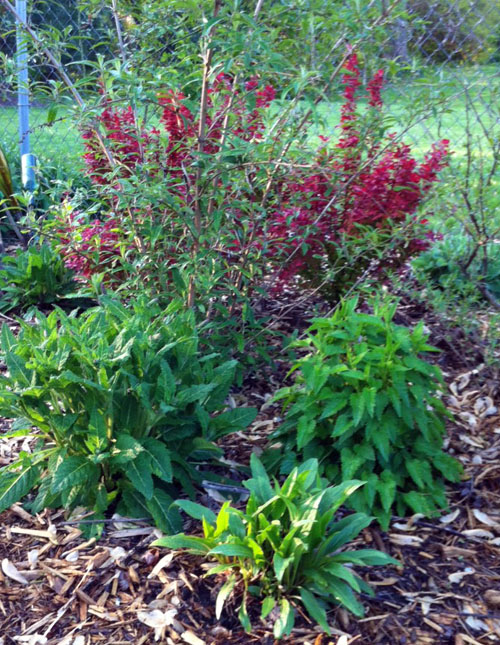
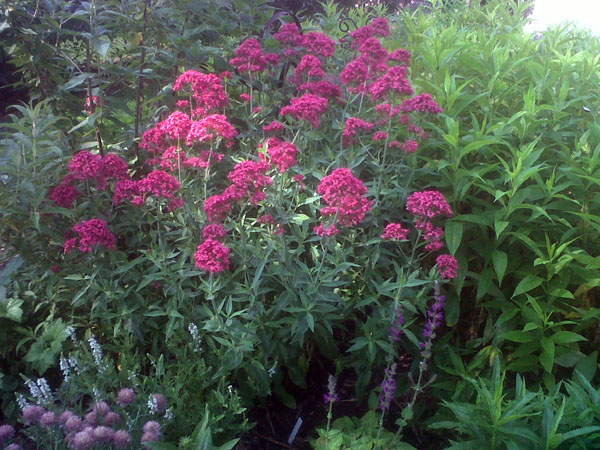
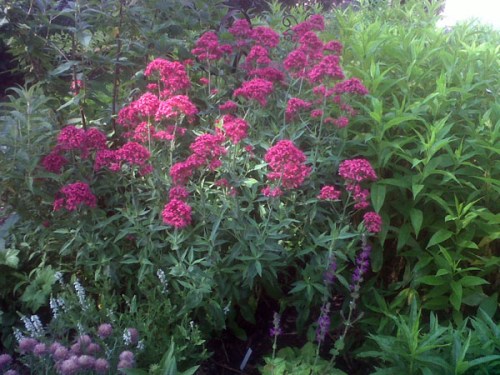
There are some successes to report. Plants that impressed me with their power to laugh in the face of drought and heat. Ornamental Oregano“Kent Beauty” (see last post) was just as fresh and lovely as ever. My two Blue Mist/Caryopteris shrubs, perhaps because they originate from the South, ignored the early arriving summer and just progressed through the season as usual, blooming in late summer and looking fabulous. Sedum, whether it’s tall or a groundcover, is a godsend. I vow to plant more next year. Sometimes, they were the only plants that didn’t look parched. For annuals, my Alyssum (from seed planted a few years ago) continued to bloom all summer.  And while the petunias got gangly, I am impressed they continued to live in my planter on the patio all season. But my favorite most beloved plant this year was my Red Valerian plant (Centranthus ruber “Pretty Betsy). It’s lovely cool green leaves have resisted disease, drought, insects, everything, and it keeps producing rounds of red flowers all summer, from way back in May till now. When I find another one of these in the store next year (it’s still hard to find and it is not the sort of plant you can divide), I am snatching it up. You must build your team (or your garden) out of winners if you want to make it through a tough season. 
A Delicate Beauty

When I saw this in the garden center a few years ago, I had to have it. It is an ornamental oregano (origanum rotundifolium) called “Kent Beauty.” Only after I planted it did I read more about the plant and find that while it is technically hardy to Zone 5, it can be fussy about overwatering, high humidity, and cold winters. All of which are a risk in my area. I thought perhaps it wouldn’t survive past one season. But it’s been three seasons now and the plant is thriving. In this photo it is in full flower. The flowers develop as pink “leaves” on the stems. The plant is lovely just as foliage, but the flowers are phenomenal. It’s definitely worth trying this plant in your garden, even if you have to experiment with location. Sometimes it is sold in fancy pots in garden center hot houses, but trust me, it’s tougher than it looks despite its delicacy.

Season of Distress

I haven’t been posting to this blog at my usual rate this year. That is because a season’s worth of blooms are whooshing by in the blink of an eye, giving me scant opportunity to enjoy the usual parade of blooms in my summer garden. I admit to finding this phenomenon alarming. Thanks to the record warmth of the winter and spring and an official drought in Illinois, my late June garden is looking like mid-August. In the panoramic shot below you can see the bizarre results. We have coneflowers, lilies, balloon flowers, and bee balm already blooming. The Joe Pye Weed and the liatris are on the cusp of blooming (unheard of in June), and the butterfly bush has had flowers for weeks already. The vegetable garden hidden behind these flowers is growing slightly behind its usual rate, having been planted only a month ago and not enjoying the drought and the heat. It makes me wonder what will happen in August. Will most of the flowers be spent? Will they rebloom? Will my garden look like a battle zone? Only time will tell.