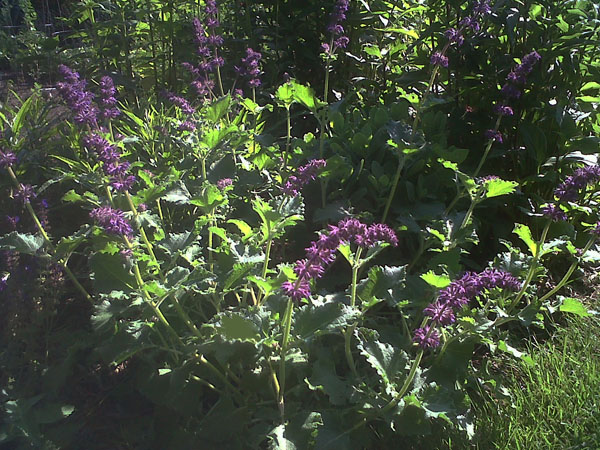
It is unusual to find a plant in the store once and then never again. By the time they make it to the store, they are usually field-tested and approved and they tend to stick around. Yet oddities do occur. Such as “Purple Rain” Salvia. I bought it about 6 years ago after seeing it on a nursery shelf and have never seen it again. If you Google it, you’ll find mention of it, but no one selling it. Why not? I have no idea! This has been an awesome plant. Reliable, gorgeous, resistant to disease and bugs, cool curly leaves, and long-lasting flowers. Did Prince have an issue with the name? (If there were a plant detectives TV show, I’d put them on the case.) I’d try to make more through division but it’s not really a plant that seems conducive to dividing, and to be honest, I hesitate to take a sharp spade to it when it might be one of the only Purple Rain Salvias in the world. And so it remains, an enigma in my yard. Just goes to show you that you should never pass up that unusual variety that catches your eye because you might just blink and miss it.
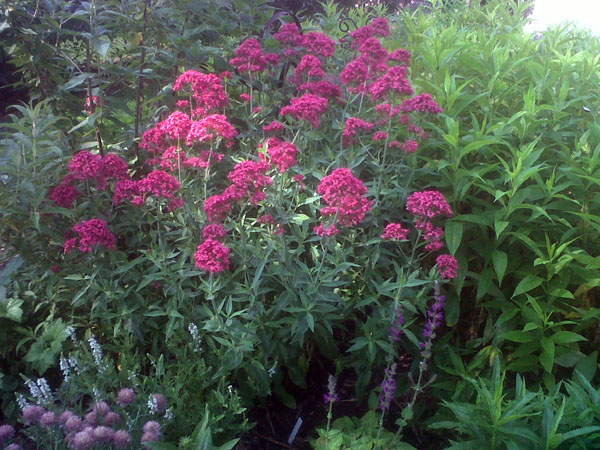
I bragged on Centranthus ruber ‘Pretty Betsy’ a couple years back, but this plant reminds me every year how fabulous it is. I really can’t understand why it is so difficult to find this in the store. It should be sold everywhere along with coneflowers and tall phlox. I got mine years ago through mail order, although I have seen it once or twice since in the stores. The particulars: Hardy to Zone 4, 3 feet tall and wide, lovely branching form with bluish-green oblong leaves, cherry red flowers from May through August (which are more plentiful if you deadhead regularly), good for cut flowers. It is supposed to spread by seed, but I haven’t been that lucky yet. As you can see, it is blooming now. About the only thing it doesn’t have is scent. And the bees don’t like it for some reason. (Perhaps it makes them sleepy?) But overall, wow, one of the most reliable, knockout gorgeous plants I own.
Posted in Uncategorized | Leave a Comment »
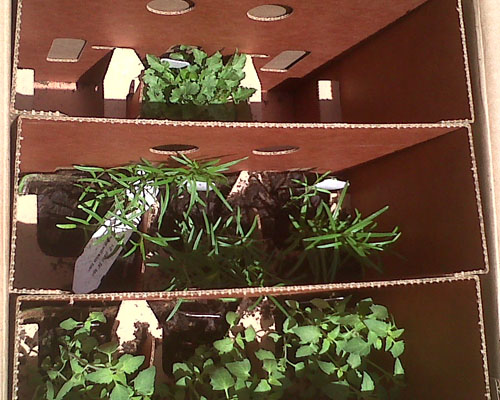
I have had quite a few experiences over the years with mail-order plants. Some of them started out rough. Shipping can take its toll on tiny seedlings. A few plants have arrived looking sad and broken and died shortly after arrival. On the plus side, all the companies I’ve ordered from have sent me replacement plants if needed (sometimes those died, too, but I appreciate the effort). I try not to order often through mail-order because so many varieties of plants can now be found in local stores. However, I do usually indulge in one small box per year when I see unusual plants. My favorite vendor is Bluestone Perennials because they get better at packing every year. They’ve gone from biodegradable peanuts in the box to this truly innovative system of using cardboard restraints to keep the plants in place while letting them breathe. As you can see from the photo, these pots aren’t going anywhere. Plus this year, the plants ship in biodegradable pots made from coconut husk fibers (coir) . This not only allows the little seedling to “breathe” better, but you plant the whole pot! This reduces stress to the roots of the plant and gives it some compost, too. Excellent plan. I’m excited to see how it works.
Posted in Uncategorized | Leave a Comment »
At a time when traditional lilacs have finished blooming, the Dwarf Korean Lilacs are just beginning to bloom, making them a great way for lilac lovers to extend their season of happiness. As you can see from the photo, the fullness and compact size of the shrubs (the ones shown are at full height and are actually three shrubs grown in close proximity) make them a perfect addition to landscaping near the house. To keep them tidy, just be sure to shear back up to a foot each year (depending on the height you want to maintain) after they bloom. Another great thing about this shrub is that the flowers are everywhere, from top to bottom. And they are reliably that way year after year. Simply awesome blossom coverage. And their smell is particularly sweet, their petals particularly dainty. If you want a low maintenance, reliably flowering shrub, you really can’t go wrong with this one.
Posted in Uncategorized | Leave a Comment »
Actually, I don’t know if these are good people. I just saw this house while out for a walk recently. For all I know, these people deserve their landscaping.
You can see why they felt the need for some landscaping in this street-facing side yard of theirs. They have a blindingly white faux-wood picket fence that needed to be softened. They also have very little space between the fence and the sidewalk. So some helpful landscaping company (and it was a professional company…I saw them planting these) came up with the brilliant plan of “arborvitae, daylily, arborvitae, daylily” all the way down this very long stretch of fence.
Now I’m a fan of arborvitaes. I have them along the fence in my backyard. They can provide great cover for an unappealing fence. However, one should never assume the same plants will grow up at the same rate. You never know what flaws may be lurking in the plants or the ground below them. And when you set up landscaping with such a highly visible pattern as in the photo above, you are setting yourself up for a disappointing result if one or more of the plants suddenly becomes stunted or diseased. Not to mention, who had the idea of daylilies here? Not that they aren’t pretty flowers, but let’s face it, they give you flowers for about two weeks in midsummer and then you are left with nothing but spidery messy foliage for the rest of the season. Ugh.
I’m not sure how I would’ve handled this issue. Perhaps I wouldn’t have tried to cover the entire length of the fence, choosing instead a few pockets of landscaping activity. Or perhaps I might’ve gone with a shrub that is nearly indestructible no matter how hard you have to prune it, like honeysuckle. For filler plants, I would’ve chosen catmint. They give you full, reliable foliage and purple flowers ALL summer, not just for two weeks. Arborvitae can be fussy shrubs and all their flaws will be exposed in the arrangement above. I’ll be interested to see how this plan pans out over time.
Posted in Uncategorized | Leave a Comment »
I have stopped gardening for a little while. I trimmed down the winter’s dead foliage, I weeded, I divided, I moved a few plants around. I’ve been picking and fussing at my beds for weeks. Now it’s time to let things be, just let things be, so the plants can go on their next growth spurt when they’re ready. It’s easy to over-garden in the Spring. At some point, you just need to hang back and let the rain and the sun do their thing. A watched flower doesn’t grow any faster. And beware of digging up weeds that aren’t actually weeds (always a danger when plants are small).
The bleeding heart plant in the photo below is the perfect mascot for the hands-off policy. The key to this plant coming back every year is to plant it in the right spot (semi to full shade) and then not touch it. It usually dies back to the ground by mid-summer, completely disappears, so I have to mark its spot with something so I don’t forget and dig it up next year. And then in the spring, without any interference from me, this happens. Magic, unaided by my meddlesome gardening.
Posted in Uncategorized | Leave a Comment »
It happens at least once a year. Usually early in the season. I am at the garden center for my first big perennial shop and there it is, that flower I have never seen, never heard of before. All I have to go by is its tag and the promise of what is to come. Should I take the chance? Is it a good risk? If it’s under 10 bucks and in my zone or lower, I will usually take that risk. I’d say I’m running at least 75% favorably when it comes to these risks being good ones.
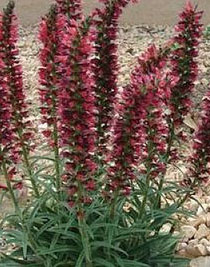
This past week’s risk is Echium amoenum ‘Red Feathers’ or Bugloss. The tag says it ‘forms very low-growing mounds of narrow dark green leathery foliage, with feathery flowering spikes in spring with a multitude of russet-red florets. ‘Red Feathers’ boasts an exceptional long bloom time and plants will rebloom in summer and fall if properly deadheaded. Thrives on neglect!’ Add on to that hardiness down to Zone 3 and this may be a dream plant indeed.
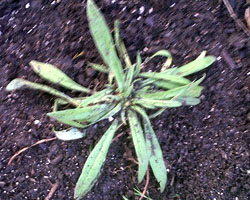
So I bought it. Because even though it currently looks like this:
It is supposed to look like this:
That’s part of the thrill of the hunt. And of gardening in general. Who would think that pathetic little spidery piece of greenery would ever turn into something amazing? But more often than not, it really does. Magic.
The next step of the process of taking in a new plant friend is doing more research online about its history. Mr. Red Feathers here has come quite a long way. This plant is native to northern Iran and the Caucasus Mountains, where it has historically been used for medicinal purposes. The flowers get made into a tea that is supposed to treat anxiety. So if you have some anxious bees in your yard, send them to me.
I am a little amazed to have this plant in my yard with such exotic origins. Will it do well this year? We shall see (and we shall post photos here). The bigger question is will it come back NEXT year? And will I be happy I bought it? At only $6.99, I have to say there are worse risks to take. What can I say. I am an adventurer at heart. A very thrifty adventurer.
Posted in Uncategorized | Leave a Comment »
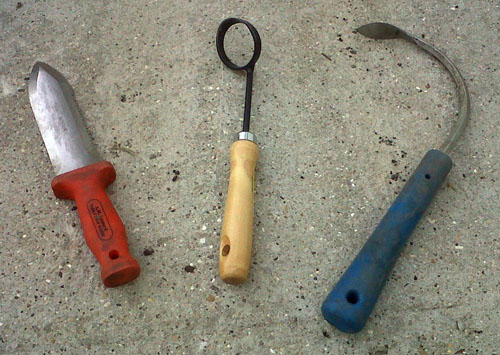
Way back when I started this post, I talked about “tools of the trade.” I think this advice bears repeating. There are three weeding/cultivating tools in my gardener’s arsenal that continue to prove invaluable year after year. They are: the Garden Knife, the Circle Hoe, and the Cobrahead. These three products have saved me many hours of weeding time over the years. They work shockingly well. Let me break them down for you.
The Garden Knife [left] is super-strong with a serrated edge (and its own holster!). This is a great tool for slicing out deep weed roots in tricky, narrow places. Such as when you need to get invasive grass out from within and around a patch of valuable perennial. It’s kind of like a surgical tool, precise and targeted. You can also use it to slice out small plants for transplant or to dig holes for bulbs.
The Cobrahead [right] is awesome for big, obnoxious weeds with long roots like dandelions and thistle weed. It’s especially good for spot lawn weeding. The head has a very sharp blade and it’s shape really digs under the ground to pop out the weeds quickly and completely in one swoop.
My favorite by far, though, is the Circle Hoe [center]. The one in the photo is the smallest size, good for precise weeding around delicate flowers. I also have a medium-size handle version for a longer reach and my favorite, a long-handled version that lets me weed/cultivate while standing and that easily handles deeply rooted weeds, too. You can purchase them as a set. The bottom of the circle is a sharp blade that cut through the weeds/dirt, which then pass through the opening in the circle. You can slice through the hardest ground and the toughest weeds like butter. I let my new neighbor try it last summer and he was amazed. Seriously, if you buy just one kind of new tool, make it the Circle Hoe (the whole set if you can). It’ll rock your world.
Posted in Uncategorized | Leave a Comment »
Well, this IS a big deal for me. My 100th post to this little blog in less than two years. If I lived in a place with warm winters, who knows how many posts I’d have by now. Of course, with the warm winter and spring we’ve had, who knows what the future holds.
Speaking of said warm spring, after two weeks in the upper 70s and lower 80s, all the growing things are out of whack. The crocuses, daffodils, forsythia, and magnolia trees are all blooming now, at the same time. The latter three should not be blooming till April, April, and May, respectively. My lilac bushes are nearing bloom, as well as my viburnum and hyacinths. In March. I can’t even imagine what’s going to happen in April and May. All our gardening expectations have been thrown out the window. We are the New South.
One consequence of the warm winter is a plethora of grass in my flower beds. There is always some that creeps in and must be pulled out every spring, but this has reached epic proportions. I have been wielding my garden knife quite heavily in recent days trying to find the little perennials under the large tufts of invasive grass.
A more positive (yet still slightly alarming) consequence of the warm weather is that plants that spread have spread to an unprecedented level over the winter. For example, I have enough bee balm to populate several gardens now. I will be looking for good homes for a few clumps this spring.
No one looking at my flower beds now would ever expect them to look like the photo below. It’s pretty much a shorn wasteland at present, with little green tufts at ground level. If you want to convince someone to become a gardener, I wouldn’t let them see your garden right now. You’ll scare them off. Every spring I am amazed at how things grow in the space of a few weeks. Although this year, I wonder if I’ll have coneflowers in May instead of July!
Posted in Uncategorized | Leave a Comment »
“IT’S A SPREADER,” I screamed into the March wind yesterday, much like a spotter on the boat in Moby Dick. Every now and then, a plant surprises me. One way it can do so is by unexpectedly spreading to three times its size and encroaching on other nearby plants, all in the space of one dormant season. Plants that spread can be a good thing. Sure, we all have more Shasta Daisies and Black-eyed Susans than we’ll ever need, but it’s generally great to have plants that make more of themselves, as long as the spread is slow and easily controlled. Some plants spread by seed, and these, while they can be annoying, are usually easily pulled out where they are unwanted. More often, plants spread via the root system, like Shastas. But there are roots and there are ROOTS. I once planted something called a Mexican primrose that I found out, two weeks after I planted it, can be an aggressive spreader. So aggressive, it was recommended it be planted in a pot. Yikes. A little exploratory digging had shown it had sent out root runners (aka “rhizomes”) a good two feet out from the main part of the plant below ground. YIKES! I dug that puppy out of the ground pronto and threw it away. I did not need that much primrose.
I’ve learned to respect and sometimes fear the term “spreads by rhizomes.” When I see a plant with that tag, I make sure I do some research to see how aggressive it is. It’s not necessarily a bad thing. Many plants that spread by rhizomes are gentle and slow in their growth. Non-invasive.
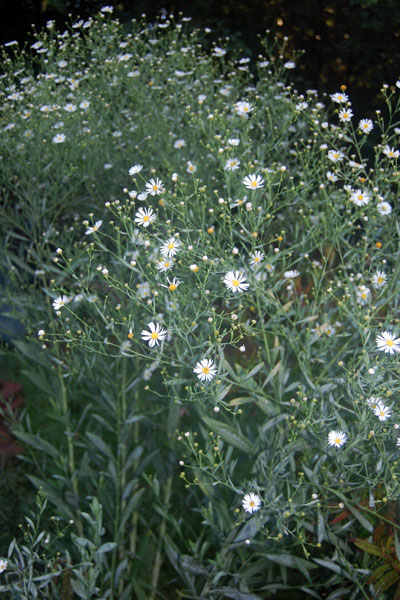
So, back to my expression of horror/surprise yesterday. My fairly new “Boltonia asteroides” (an American wildflower also called Wild Aster…see photo) is about two years old. I knew it was a quick grower because at one year old, I was able to give an extra clump bigger than I originally purchased to my mom. But when I looked yesterday, there was a huge field of new green leaves popping up from the ground around it. Way more than I needed in that spot. I feared I had planted a monster. Then reason prevailed and I fetched my handy Cobrahead tool and started digging. The roots under each leaf clump were very robust (looked kind of like a pale miniature octopus), but they were thankfully only about 3 inches long and in a compact bundle. Easy to remove from areas where it was encroaching on other plants. Whew. Glad I found that out before those little bundles got entrenched. (Wildflowers definitely know how to entrench.)
I’m not about to dig up this gorgeous plant, which is a favorite of mine. But now I know to watch it carefully. VERY carefully. And by the way, if you want some, you know who to call.
Posted in Uncategorized | 2 Comments »