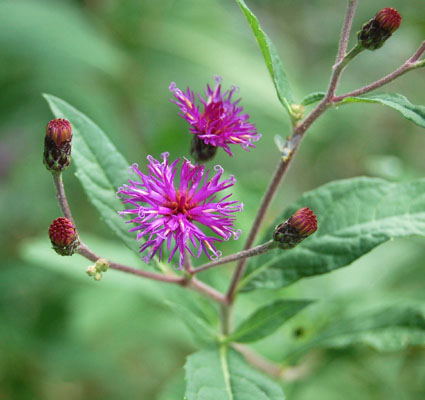
It is September and the plant otherwise known as “Ironweed” that I purchased early this year is 3 feet tall and flowering as promised. As you can see by the photo, it’s much too pretty to be called Ironweed (its other name “Vernonia fasciculata” is more appropriate). Yet I do get perverse delight in calling lovely native plants by their often ungainly names, like Ironweed, Swamp Milkweed, and Joe Pye Weed. You note the trend there…the word “weed” pops up often. Thus proving the old adage that weeds are only flowers in undesirable places. I wouldn’t go that far. My native plants do not seem to be in the same league as the detestable dandelion. Yet a visitor to my garden recently pointed out, ‘I can tell it’s a native plant because it’s tall and stalky.’ Yes, native plants are often a bit lean and rangy. They definitely assert themselves in the landscape, which makes them charmingly American, I think. Maybe somewhere in an English cottage garden, there’s a British gardener coveting our “weeds.”
 The two fluffy white Limelight hydrangeas in this photo are not different sizes due to forced perspective. The one in the foreground is more than twice the size of the one in the background. Both shrubs were purchased at the same time from the same store and started out the same size, one on either side of my front door. The smaller shrub is actually in better quality soil than the larger one, which is kind of stranded on a patch of earth between the sidewalk and driveway. The difference? Sunlight! Both face west, but the smaller shrub gets shading from the house, whereas the larger shrub is outside of the shade’s influence, on the corner of the house. It gets full sun from almost all sides. I believe this shows the difference the sun can make to sun-loving shrubs.
Posted in Uncategorized | Leave a Comment »
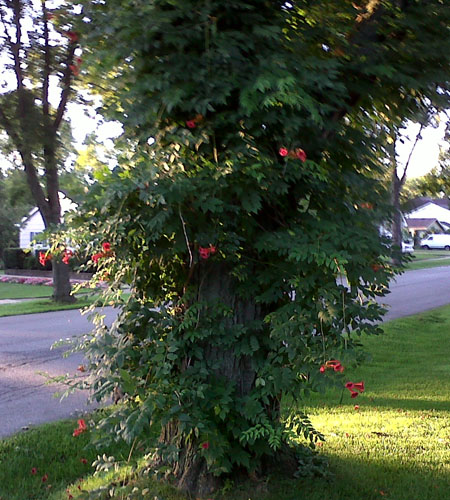 I had to snap a photo of this amazing sight I saw while walking around the neighborhood this morning. At first, I thought the trees were starting to turn colors a bit early. Then I realized these weren’t orange leaves, but orange flowers. Yes, my friends, this person is growing an extremely large bugle vine on an extremely large tree. The vine goes up about 16 feet or so. Since the tree is on a corner, it’s getting enough sun from the sides. I do wonder what the squirrels think about this, but I admire the fact that someone finally found a place where a bugle vine has enough room to grow to its full height.
Posted in Uncategorized | Leave a Comment »
 This was a shot of my vegetable garden from about two months ago when everything was full of promise. Let’s focus on that shot, because the current one isn’t as pretty. For the fifth year in a row, I have proven a mostly unsuccessful vegetable gardener. I don’t know how the farmers in Illinois ever grow a crop with our bizarre weather. My one success this year was preventing early blight on my tomatoes. I think it was the regular application of liquid copper fungicide. These are the tallest tomato plants I’ve every had…and the leaves have stayed green, too! I’ve had one great tomato harvest and now am hoping for another good crop of tomatoes to prove that I really was successful at growing them this year.
To me, as long as I have a good tomato crop, I count myself lucky. There is no substitute for a home-grown tomato. Fortunately, there ARE substitutes at the store for my garden fails, like cucumbers and pumpkins. I learned that you can’t get cucumbers or pumpkins unless the bees do a good job fertilizing those pretty yellow flowers. Blame the world-wide bee blight, but my flowers did not turn into pumpkins or cucumbers. And then last week the blight set it anyway and turned all the green leaves to brown-spotted horrors. The vines have been excised. Garden fail. On a related note, the lettuce turned out bitter this year (won’t be trying that again) and the cilantro was pickable for only a heartbeat. Barely worth planting. Peppers also give me trouble. The bell kind anyway. So far, I have had one excellent pepper from each plant. Just the one pepper. Can’t explain why exactly.
The pole beans are interesting looking. A pretty green wall. The bean yield has been sparse, but at least they are still alive and producing. Therefore, they make the cut. What cut? The cut of the crops I’ll grow from now on. I am done with cucumbers, squash, pumpkins, lettuce, and most herbs. Next year, I am only growing tomatoes, jalapenos, and bell peppers (despite their sparse yield), plus another go at the pole beans. I have had enough of struggling to grow anything else. As with my flower garden, I’ve learned what is hardy and thrives. Half the job of being a good gardener is knowing when to cut your losses and change plans.
Posted in Uncategorized | Leave a Comment »
 Who can resist the plant sales that start in August? It’s like you realize the winter is coming and if you don’t buy plants now, you’re out of luck till next May. That’s too long a wait to contemplate for me. Plus, I’ve gotten some of my most unusual and beloved plants in August. August is a great time for buying fall bloomers and prairie plants. For the third year in a row, I’ve purchased an exciting prairie plant. This one is “Aster azureus” or “Sky Blue Aster.” If you live in the middle or eastern part of the country, this is probably the same tall blue aster you’ve seen by the sides of the road and in fields. It is supposed to tolerate any soil type imaginable and still thrive. My kind of aster! I love asters, but have so much trouble with rust and mildew on my old-fashioned short varieties that I’ve given up on those. This will be a tall, majestic beauty next August! (Right now it’s a pathetic few canes, kind of like a Charlie Brown plant.) I planted it next to my white “Swamp Aster” which is also a prairie plant. Should be an outstanding combo. Also purchased on this plant sale shopping trip was Harvest Moon Coneflower. Not my showiest coneflower, but an arresting light orange color with a pretty cone. And finally, Plumbago or Leadwort. This was a groundcover recommended to me by my mother. It blooms with deep violet-blue flowers this time of year, when flowers are most needed. All three plants were rather root-bound (one of the hazards of late season shopping), but some extra attention opening the roots up should fix that. I wish my three new babies good health for years to come.
Posted in Uncategorized | 2 Comments »
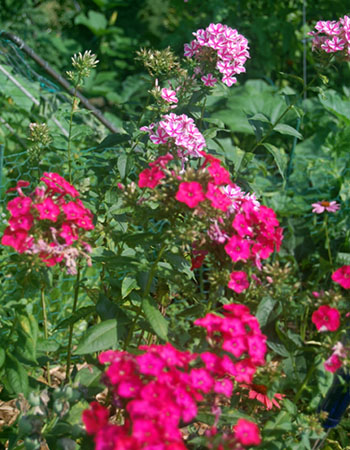 Okay, I’m being a bit dramatic. We gardeners are sensitive people. But tall phlox truly are a mixed bag in any given summer. Prone to powdery mildew, this plant has its good summers and its bad. I have collected varieties that promise to be mildew resistant, but not all live up to their claims. (Regular application of a liquid copper fungicide can sometimes help, but it rained too much to apply it regularly.) This summer, my usually hardy and spectacular Blue Paradise Phlox were taken out early by the incessant rains. But two newer varieties, planted just last summer, were surprising winners. Not only did they avoid the dreaded mildew, but they bloomed two weeks later than my other phlox, meaning that they have single-handedly extended my phlox season. Shown in the photo is Red Volcano and Candy Stripe Volcano (“Volcano” being a brand of phlox bred for mildew-resistance). The red is an unusually deep, hot pink and the candy-striped looks just as promised. A dazzling combination, I think.
Posted in Uncategorized | 1 Comment »
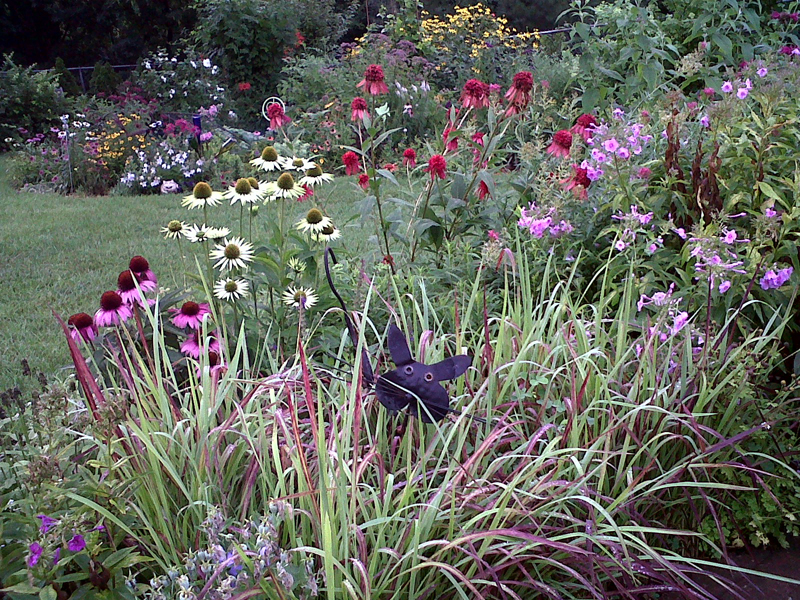
Depending on where the first frosts are in our future, we have maybe two solid months of flowers to enjoy before autumn strikes. Since the bulk of my garden started up in May, I am now two months in with about two months left to go. It has been a remarkable July. First, we had a drought that stood to make this the driest July on record, then we had torrential rains that made this the wettest July on record. I am hoping for the sake of my vegetable garden that the weather now equalizes a bit. But the flowers, I must say, are thriving, despite the extreme conditions. If this July isn’t proof of the power of native flowers, I don’t know what is. Much of my garden has its roots in native plants (even though they have been hybridized somewhat), and it takes more than record drought and flood to take out a coneflower! Here’s a small snap of what I’ve got going on at present. Lots of color, lots of fun shapes and sizes, and lots to enjoy.
Posted in Uncategorized | Leave a Comment »
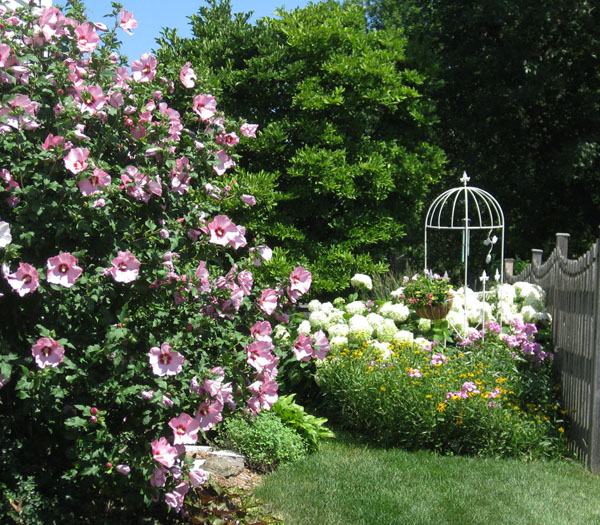
Many gardens are not looking so fine at this point in the summer. And rarely do I see an entrance to a garden that makes me go “wow.” So it is with double the pleasure that I post this photo from my garden mentor, my mother, taken just this week. As you walk from the front of her house, around the side and into the backyard, you are greeted by an Aphrodite Rose of Sharon (on the left) and an old-fashioned charmer of a combination of yellow black-eyed susan, pink phlox, and fluffy white Annabelle hydrangeas on the right. Plus a nifty wrought iron garden decoration. I even enjoy the magnolia tree in the middle of the photo, which has bright green foliage all summer. If you have a fabulous backyard, you probably already have some flowers spilling over to the front, but it’s fun to consider what glimpse of your yard passersby get as they walk by.
Posted in Uncategorized | Leave a Comment »
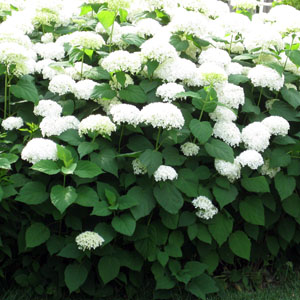 I love love LOVE Annabelle Hydrangeas. They are dreamy and cool and wonderful. They light up any yard and the flower heads are actually huggable, like fluffy pom-poms. This classic hydrangea is in the “Hydrangea arborescens” family and blooms on both new and old wood…a key factor for reliable hydrangeas in our colder zone. There are now pink varieties of this shrub available and while those are nice, nothing can beat this charmer, which opens white and eventually turns a cool green in late summer. They do best in areas with a little shade (Southern exposure would stress them out a bit). The only negative is, due to the size of the flowers, these shrubs can flop, especially after a storm. I used to have them by my front door, but the flopping made them a little too messy. Now they are in the backyard and can sprawl happily.
Posted in Uncategorized | Leave a Comment »
 The ornaments and trinkets we choose to display in our yards are often haphazard, but that is the charm in it, I think. Years of accumulating odds and ends through art shows, garden centers, garage sales, and your own ingenuity is the best way to achieve a customized-to-your-yard approach. I personally have a very casual, whimsical yard in terms of my flower choice. Lots of bright and unusual flowers, many of them tall, with no set color palette. So I will not be the person with the faux marble Greek lady with an urn statue. That looks great in some gardens, but I prefer my rusty metal ostrich, made by an artist from old shovels and tools. And you can’t go wrong with metal obelisks and trellises, especially those with pretty scrolled designs. It’s so easy to “redecorate” those from year to year with a can of spray paint. And they are easy to move around throughout the year if you need to cover bare spots or prop up a tall plant. And I love tiny cement animals (think frogs and bunnies) that I can tuck here and there. I prefer the unpainted kind (they never wear out) and they can dress up a blah corner in a second. This year, I finally added my own version of a “bottle tree” with brightly colored wine bottles hung from the ends of a few sturdy tree branches I stuck in the ground. I imagine the branches will rot eventually and I’ll have to re-do those trees, but that’s part of the fun. Things rust, things change. You try new things. Just like with plants!
Posted in Uncategorized | Leave a Comment »
 Cait's Garden