Uncommon Lilacs

One of my first garden projects in my new home was planting lilac bushes. I knew I wanted a couple of the traditional French lilacs, but for the third lilac, I indulged in a different variety. Shown in the photo above is my Katherine Havemeyer lilac tree. It’s more commonly called a tree than a bush because it maintains a more tree-like form than your traditional lilac bushes. It can reach up to 10 feet tall and wide, and like other lilacs, it can be carefully trimmed as needed to maintain shape. But it still blooms on old wood, so one must be careful about pruning to avoid flower disruption. And what flowers they are! Amazing, giant cones of tightly packed, large, rosey-lilac flowers. They are like traditional lilac flowers on serious steroids. Gorgeous! You have to see them to believe them. And the scent, I think, is even headier than traditional lilacs. Much stronger and spicier.

These days, there are a ton of varieties of lilacs to choose from, in colors as varied as pink, yellow, and white. There are even reblooming shrubs now. (While I like that idea, there’s something to be said for the old school way of thinking…everything to its season.) But space in my yard is limited, so although I’d love one of each variety, I just can’t indulge. Still, I’m glad to have the old standards, and I’m positively thrilled to have the Katherine Havemeyer.
Meet Judd

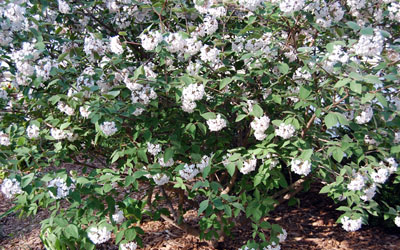
Do you have a viburnum? Do you know how to pronounce “viburnum”? (I looked it up years ago…the stress is on the Vye at the beginning of the word.) This is a phenomenal landscape plant. There are many varieties to choose from, but I can personally recommend Judd.  Judd Viburnum is a round and bushy little tree-like shrub that grows to about 5 feet tall and wide. It is hardy, it is easy to prune if you want to shape it, and it makes a wonderful focal point in any garden. I have this particular viburnum smack dab in the center of the landscaping along the front of my house. It is my anchor. And in Spring, it is covered in the most phenomenal-smelling pom poms of blush pink flowers. The smell is like a carnation on steroids. Intense warm vanilla and spicy cinnamon. Definitely one of the most incredible spring flower smells you can experience. When the flowers are gone, I’m left with an attractive, full tree with dark green leaves that turns pretty purples and reds in the fall. It is rare when a plant gives you so much enjoyment and reliability in exchange for so little care. Judd’s my man…er, shrub!

Unconquerable

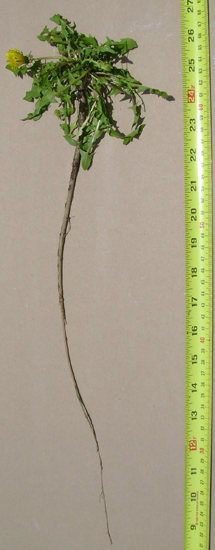
Can’t completely banish dandelions from your yard? Don’t blame your chosen brand of weed and feed. Look at how these things are engineered! These things can survive fires with roots like that.

I use corn gluten on my lawn to fertilize and prevent weeds. It’s the green choice, especially if you have lots of wildlife in your yard. And it works great overall. Certainly as well as your traditional chemicals. But chemicals or corn, you will never ever banish dandelions completely.

On the bright side, think of all the fun, dangerous-looking garden tools you can buy to fight them!

Warts and All

What began as a typically awkward spring is slowly shaping up. Plants are becoming recognizable, the lawn is green, trees and shrubs are leafing out. And my dear garden friends, the toads, are back.

I have come to adore these little guys, even though they prompt me to scream several times a summer by popping out at me unexpectedly from under a plant when I’m weeding. The toads aren’t scary…they just surprise you! Did you know that you are a lucky, lucky gardener if you have toads in your yard? Each toad can consume thousands of insects that would otherwise damage our plants. They are nature’s pest control.

A few caveats to making your yard a toad refuge. Avoid chemical sprays and pesticides, which can poison the little guys. And be VERY careful when you weed or cut the grass. Baby toads especially can hop out unexpectedly into the path of a sharp object. You don’t want the guilt of having maimed one of these little cuties. Live and let live!

In addition to spending the last couple of weekends cutting down all the dried up stalks from last year’s perennials (including buddleia) and checking for signs of life, I have been making the rounds on all my shrubbery as well. The lilacs were the first to sprout leaves and are still way ahead of the pack. Everything else is in very early leafing stages. Just little bumps you can see will be leaves.

One can never take for granted that any shrub, no matter how beloved, will come back year after year. It is always a relief to see those signs of life, especially if it is a shrub you planted last season. A first winter can bring surprises. I have two young privets in the same location; one is fine, the other shows no signs of leaves yet. I did the old “scratch test”…you know, scratch off a little bark and see if it’s green…and it is green, but I’ve learned that’s not definitive either. It’s a positive sign, but the shrub might also be on the verge of death. (If the scratch test reveals no green, abandon all hope.) Another week or two should tell for sure. By the way, one shrub you can’t do the scratch test on is summersweet…that bark is like iron. Summersweet is also very late to wake, though, so no reason to panic there yet.

I always keep my receipts for shrubs with guarantees in an easy-to-find place, and pay attention to how long I have to return them. If I’m going to pay good money for a shrub or tree, I always buy from a nursery with a one-year guarantee. Makes it alot less painful if it doesn’t come back. However, here’s hoping that all our shrubs do this year!

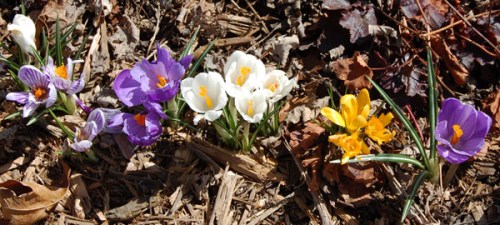
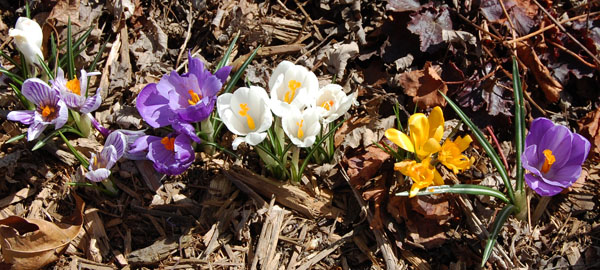
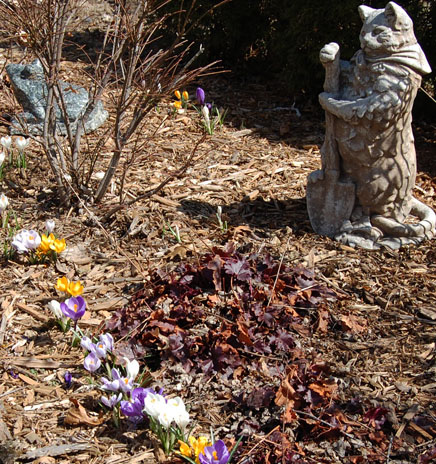
I was late to the party with crocuses. I planted my first several dozen just two years ago and am so very glad I did. (Even though I had to keep bricks on top of the bulbs the first winter to discourage squirrels from digging them up.) I put them in a low-maintenance section of  my garden, consisting of mostly shrubs, so that they can multiply freely without accidental interference from me. For the past week, I’ve been enjoying the show, with more performances to come. Some may wonder if it’s worth the trouble, planting bulbs for flowers with such a brief life span. All I’ll say to that is, FLOWERS, in MARCH. What gardener wouldn’t want to see that? For your viewing pleasure, I will also include a long shot of one section of my garden with crocuses, so I can show off my beloved gardening cat statue, who clearly is enjoying the flowers.
First Flower Battles

Look at those beautiful pansies. In the photo, I mean, because the ones I just planted last weekend don’t look anything like that yet. It’s exhilarating, yet trying, potting the first flowers of spring. Frosts aren’t the issue. For me, it’s the wildlife. Squirrels have been digging in my large pots of pansies by the front door, uprooting the plants completely. And this charming planter in the photo? Its flowers have been eaten by a woodchuck. If I can keep these flowers whole for a few more weeks, I will be in the clear. But now, it’s a comical battle.

Winter Interest

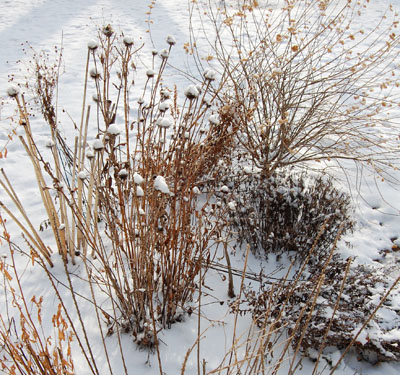
Here it is, March 2, and I hope to be making my final post of the winter season. (Or at least my last intentionally wintery post.) You hear the term “winter interest” often on gardening shows and in magazines. I think I’ve got that one covered, just by being lazy and not cutting down my perennials. Well, actually it’s good to keep the foliage on your plants over the winter to provide protection, so there is method behind my sloth.  And when the snow falls just right, it sticks in a quite lovely way to the seed heads of all those coneflowers I have. In the photo, you’ll see those, a very pretty dried out caryopteris (blue mist shrub) and a few bits of aster and coreopsis. Looks pretty nice, huh? Imagine how great it will look when it’s green again!

Shrubs Get Shrunk

Great new trend in shrubbery: miniatures! How often have you been in a garden center, seen a gorgeous shrub, and then had to pass because you don’t happen to have 6-8 feet of space left in your yard? If you’re like me, this happens a lot. Some newbie gardeners try to ignore the tag and assume they can just trim a shrub into submission for life. But that’s no way to treat a shrub! Thankfully, wonderful small hybrids of our favorite shrubs are available.

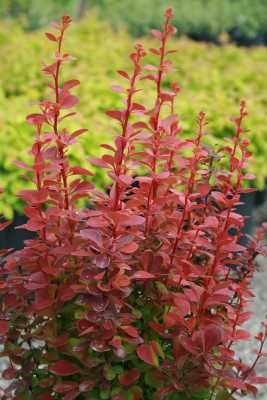
I am thrilled that there is now “Little Lime” Hydrangea (a 3-foot version of Limelight…perhaps the best hydrangea out there), “Little Devil” Ninebark (a 3-foot version of the gorgeous red Diablo Ninebark), and a few so-called “pillar” barberry bushes (like the brilliant-hued Orange Rocket, shown in the photo) that only get 18 inches wide, but 4 feet tall. I planted three of these in a corner of my flower bed just last summer. I think it’s a great idea to introduce small shrubs into flower beds. They add structure and fullness when your flowers are still growing, plus they are gorgeous in their own right. Definitely a trend to try! So say I, an aspiring gardening trend-setter.

Coming Out of Hibernation

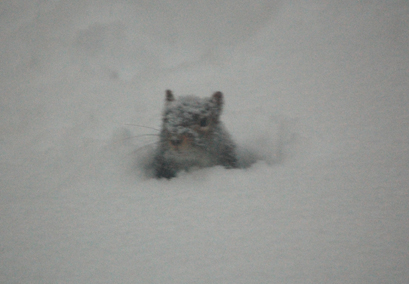
Like this squirrel, my garden is currently covered in snow. But after months  of hibernation and general sloth, this gardener is starting to get her game on again. It started small. Gazing longingly at the stack of flower catalogs I received before the holidays. But it was all a pipe dream. Until today, when the FIRST SEED PACKETS WERE PURCHASED. Yes, fellow gardeners, it’s on again. I have vegetable seeds at the ready. True, I can’t plant them until the ground can be worked, which is a few months off. But just having them makes me feel better. Before you know it, I’ll be posting about the first pansies of Spring.