“IT’S A SPREADER,” I screamed into the March wind yesterday, much like a spotter on the boat in Moby Dick. Every now and then, a plant surprises me. One way it can do so is by unexpectedly spreading to three times its size and encroaching on other nearby plants, all in the space of one dormant season. Plants that spread can be a good thing. Sure, we all have more Shasta Daisies and Black-eyed Susans than we’ll ever need, but it’s generally great to have plants that make more of themselves, as long as the spread is slow and easily controlled. Some plants spread by seed, and these, while they can be annoying, are usually easily pulled out where they are unwanted. More often, plants spread via the root system, like Shastas. But there are roots and there are ROOTS. I once planted something called a Mexican primrose that I found out, two weeks after I planted it, can be an aggressive spreader. So aggressive, it was recommended it be planted in a pot. Yikes. A little exploratory digging had shown it had sent out root runners (aka “rhizomes”) a good two feet out from the main part of the plant below ground. YIKES! I dug that puppy out of the ground pronto and threw it away. I did not need that much primrose.
I’ve learned to respect and sometimes fear the term “spreads by rhizomes.” When I see a plant with that tag, I make sure I do some research to see how aggressive it is. It’s not necessarily a bad thing. Many plants that spread by rhizomes are gentle and slow in their growth. Non-invasive.
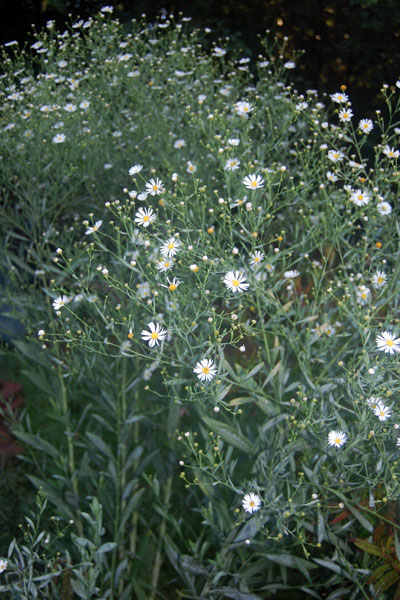 So, back to my expression of horror/surprise yesterday. My fairly new “Boltonia asteroides” (an American wildflower also called Wild Aster…see photo) is about two years old. I knew it was a quick grower because at one year old, I was able to give an extra clump bigger than I originally purchased to my mom. But when I looked yesterday, there was a huge field of new green leaves popping up from the ground around it. Way more than I needed in that spot. I feared I had planted a monster. Then reason prevailed and I fetched my handy Cobrahead tool and started digging. The roots under each leaf clump were very robust (looked kind of like a pale miniature octopus), but they were thankfully only about 3 inches long and in a compact bundle. Easy to remove from areas where it was encroaching on other plants. Whew. Glad I found that out before those little bundles got entrenched. (Wildflowers definitely know how to entrench.)
I’m not about to dig up this gorgeous plant, which is a favorite of mine. But now I know to watch it carefully. VERY carefully. And by the way, if you want some, you know who to call.
 Cait's Garden
You remind me of an unfortunate experience with gooseneck loosestrife. It took me a couple years to totally eradicate it from my garden.
I bought some loosestrife once and it died. Perhaps I should count myself lucky.